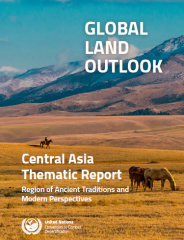
GLO Central Asia thematic report Central Asia Thematic Report Region of Ancient Traditions and Modern Perspectives The Global Land Outlook Central Asia thematic report presents a comprehensive perspective on the region as a unified ecological system in which natural processes and human activities are inextricably linked. It reminds us that the future of the region depends on recognizing the inseparable relationship between land, water and people, and on managing these resources as one interconnected system. Document 17 August 2026
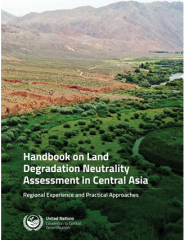
Executive Summary Handbook on Land Degradation Neutrality Assessment in Central Asia: Regional Experience and Practical Approaches The Handbook on Land Degradation Neutrality Assessment in Central Asia: Regional Experience and Practical Approaches was produced with the generous financial support of the Russian Federation for the implementation of the Roadmap of the UNCCD Interregional Group “Central Asia – Russia”. It was developed in close collaboration with a diverse group of partners and befitted greatly from consultation with and review by experts and other stakeholders. Document UNCCD resource 17 August 2026
Handbook on land degradation neutrality assessment in Central Asia: Regional experience and practical approaches This publication was prepared with financial support from the Russian Federation's voluntary contribution to the UNCCD and as part of the Roadmap of the UNCCD Interregional Group "Central Asia – Russia." The document was developed in close collaboration with a wide range of partners and significantly improved through consultations with, and peer review by, experts and other stakeholders. Document UNCCD resource 17 August 2026
The Nexus Between Land Degradation Climate Change, and Migration in Central Asia The main objective of the study is to create an interdisciplinary scientific platform, promote the development of new approaches for building further interregional cooperation and provide analytical information and data for advice/support to stakeholders for targeted actions in the region in the field of land degradation, climate change adaptation and migration, and their interrelationships to contribute to the achievement of the goals of the UNCCD Strategy for 2018-2030 and UN SDG 15.3. The Publication UNCCD resource 26 September 2025
Regional factsheet on Central Asia In Central Asia, governments and international organizations have undertaken significant efforts since the 1990s to inventory, develop, and promote sustainable land management (SLM) practices, which encompass both traditional methods specific to the region and innovative approaches aimed at mitigating and addressing emerging risks and issues stemming from climate change and land degradation. Over the years, UNCCD-spearheaded activities in Central Asia have included the preparation of national Document UNCCD resource 24 September 2025
Regional strategy for drought risk management and mitigation in Central Asia for 2021-2030 Regional strategy for drought risk management and mitigation in Central Asia for 2021-2030. This document was prepared by the Regional Environmental Centre for Central Asia (CAREC) with the support of the Interstate Commission on Sustainable Development (ICSD) and with financial assistance from the United Nations Convention to Combat Desertification (UNCCD) within the framework of the project “Regional Approaches to Combating Sand and Dust Storms (SDS) and Drought in Central Asia.” Publication UNCCD resource 10 April 2025
Science-policy brief: Sustainable land use systems – the path forward to collectively achieve Land Degradation Neutrality This publication presents science-based evidence concerning sustainable land use systems (SLUS) and the potential of the SLUS approach to achieve land degradation neutrality (LDN) targets, reduce inequalities, achieve social justice, improve economic viability and, consequently, help achieve multiple United Nations sustainable development goals (SDGs) and targets. It aims to guide countries to use SLUS to apply more effective management of natural resources and the environment. Publication UNCCD resource 10 April 2025
Science-Policy Brief: The Global Threat of Drying Lands – Regional and Global Aridity Trends and Future Projections For the first time, the aridity crisis has been documented with scientific clarity, revealing an existential threat affecting billions around the globe. The analysis points to human-caused climate change as the primary driver of this shift. Greenhouse gas emissions from electricity generation, transport, industry and land use changes warm the planet and other human activities warm the planet and affect rainfall, evaporation and plant life, creating the conditions that increase aridity. Publication UNCCD resource 10 April 2025
Promoting synergies between Land Degradation Neutrality and climate change adaptation The report is envisioned as a supplement to the guidelines of the NAP process. It offers a step-by-step approach to integrating the principles and objectives of the Land Degradation Neutrality (LDN) framework within climate change adaptation planning. It identifies where and how these broad goals intersect, and it reveals how activities, knowledge, training, monitoring and funding sources can be better leveraged when they serve both climate change adaptation and LDN. Publication UNCCD resource 10 April 2025